ABOUT ZOMBIE BRIGADE
Colonel Jack O’Neil, Zombie Brigade Commander
COLONEL JACK O’NEIL
Commanding Officer — Zombie Brigade
Colonel Jack O’Neil wasn’t always one of the undead.
In 1942, while serving with the U.S. Army Air Forces, Jack and his unit were assigned to a classified operation involving the recovery of an experimental biological agent from somewhere deep inside enemy-held territory.
What happened n
COLONEL JACK O’NEIL
Commanding Officer — Zombie Brigade
Colonel Jack O’Neil wasn’t always one of the undead.
In 1942, while serving with the U.S. Army Air Forces, Jack and his unit were assigned to a classified operation involving the recovery of an experimental biological agent from somewhere deep inside enemy-held territory.
What happened next remains buried in military records.
The official report listed the mission as a total loss.
It wasn’t.
During the operation, Jack was exposed to an unknown experimental virus. Within hours, his condition deteriorated. His pulse slowed. His body temperature dropped. Doctors pronounced him dead.
Three hours later, Jack opened his eyes.
But something had changed.
The virus had transformed him into something military doctors had never seen before. Jack wasn’t completely human anymore—but he wasn’t completely undead either.
His aging slowed almost to a standstill. Wounds that should have killed him healed. His strength and endurance increased. And unlike the infected creatures beginning to appear around him, Jack retained his intelligence, memories, personality…and his loyalty to his country.
The Army Air Forces quickly realized that Jack wasn’t simply another victim of the outbreak.
He might be their best weapon against it.
His existence was classified, his military records sealed, and Jack was placed in command of a secret unit assembled to contain the growing undead threat.
They became known simply as:
ZOMBIE BRIGADE.
Through the remaining years of World War II, Colonel Jack and his crews fought a war that never appeared in the history books—recovering aircraft, defending isolated airfields, hunting infected soldiers and battling outbreaks before they could spread beyond the battlefield.
The war ended in 1945.
Jack’s war didn’t.
More than eight decades later, the virus still flows through his veins. He has barely aged, his humanity locked in an uneasy balance with the infection that should have killed him in 1942.
He has watched generations come and go.
He has watched aircraft change from piston fighters to jets.
And somewhere along the way, the military simply stopped asking how Colonel Jack O’Neil was still alive.
Today, he remains exactly where he has always been—
with his aircraft, his crews, and his mission.
Half human.
Half undead.
100% American.
Colonel Jack O’Neil
Commanding Officer, Zombie Brigade
THE DEAD DON’T SURRENDER.
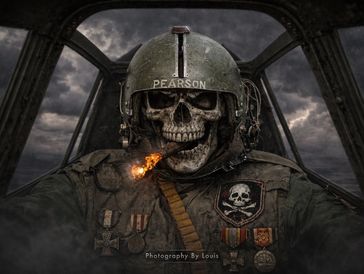
Colonel Pearson
Colonel Pearson commanded German armored forces when the zombie outbreak swept across Europe during WWII. Somewhere along the Eastern Front, Pearson encountered the infected and became one of them — but unlike the mindless undead, he retained his intelligence, military training and instinct for survival.
Now seemingly immortal, Pearson con
Colonel Pearson commanded German armored forces when the zombie outbreak swept across Europe during WWII. Somewhere along the Eastern Front, Pearson encountered the infected and became one of them — but unlike the mindless undead, he retained his intelligence, military training and instinct for survival.
Now seemingly immortal, Pearson continues to command from the turret of whatever German armor he can get his hands on. Friend, enemy or something in between, one thing is certain — after more than 80 years, Colonel Pearson is still in the fight.
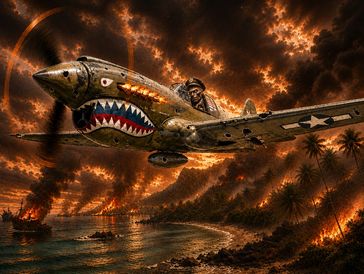
“COLONEL JACK TAKES TO THE SKIES” HE’S ON THE HUNT FOR THE UN-DEAD!
“COLONEL JACK TAKES TO THE SKIES” HE’S ON THE HUNT FOR THE UN-DEAD!
Colonel Jack O’Neil takes to the skies in his battle-scarred P-40 Warhawk as the zombie outbreak spreads across the Pacific. Infected during the first outbreak of 1942, Jack became something neither living nor dead — and he’s been fighting the undead ever since. The war may have changed, but the mission hasn’t: GET SOME!

“THE PARLAY — 1945” “Cease Fire — Not Surrender.”
“THE PARLAY — 1945” “Cease Fire — Not Surrender.”
“COLONEL JACK TAKES TO THE SKIES” HE’S ON THE HUNT FOR THE UN-DEAD!
THE PARLAY — 1945
When Enemies Shared a Drink
Somewhere in the ruins of Europe — 1945
For three days, the guns had barely stopped.
Colonel Jack O’Neil and his battered American fighter group had been fighting their way east through what remained of Europe. Across the ruined airfield, Colonel Pearson and the survivors of his German command had
THE PARLAY — 1945
When Enemies Shared a Drink
Somewhere in the ruins of Europe — 1945
For three days, the guns had barely stopped.
Colonel Jack O’Neil and his battered American fighter group had been fighting their way east through what remained of Europe. Across the ruined airfield, Colonel Pearson and the survivors of his German command had been doing exactly the opposite.
They had fought one another in the skies.
They had buried men because of one another.
Under any other circumstances, only one of them would have walked away from this airfield.
But these were no longer ordinary circumstances.
The radiation had changed everything.
The dead were walking. Entire towns had disappeared behind walls of smoke. Military units had stopped answering their radios. Governments were collapsing, supply lines were gone, and somewhere along the way the war between nations had become a war between the living and the dead.
Then, shortly before sunset, a lone German soldier walked across the shattered runway carrying a white cloth.
Pearson requested a parlay.
Jack agreed.
At dusk, the two colonels met between their aircraft—Jack’s battered P-40 on one side and Pearson’s battle-scarred Messerschmitt on the other.
No headquarters.
No generals.
No politicians.
Just two old enemies sitting across a wooden table while their men watched from opposite sides of the field.
Pearson brought a bottle of wine recovered from the ruins.
Jack brought two glasses.
For several minutes neither man spoke.
Finally, Pearson poured.
“Tomorrow,” Pearson said, raising his glass, “we can go back to trying to kill each other.”
Jack stared across the table.
“Tomorrow?”
He looked toward the burning city on the horizon.
“Colonel, I’m not convinced either one of us has a tomorrow.”
Pearson smiled.
For the first time that evening, Jack did too.
They spread a map across the table.
Intelligence from both sides told the same story. Something enormous was moving toward the airfield—thousands of infected soldiers and civilians, drawn by the fires and noise of battle.
Neither force could stop it alone.
Pearson pointed toward the eastern approaches.
“My aircraft attack here.”
Jack studied the map.
“And mine hit them from the west.”
Pearson nodded.
There was a long silence.
Then Jack raised his glass.
“One night, Pearson.”
Pearson lifted his.
“One night, Jack.”
The glasses touched.
And with that simple toast, one of the strangest alliances of the Second World War was born.
American and German mechanics worked beside one another through the night. Ammunition was shared. Fuel was transferred between aircraft. Pilots who had tried to shoot each other down only hours earlier now studied the same maps and planned the same attack.
No surrender had been signed.
No peace treaty existed.
Neither colonel trusted the other completely.
But when dawn came, American and German engines started together.
For the first time, Jack’s Warhawks and Pearson’s Messerschmitts took off from the same runway—not as enemies…
…but as the first air wing of what would eventually become known as the Zombie Brigade.
The bottle remained on the table.
On its label someone had written three words:
CEASE FIRE — NOT SURRENDER.

Colonel Pearson with his ME 262 Jet Fighter
“THE PARLAY — 1945” “Cease Fire — Not Surrender.”
Colonel Pearson with his ME 262 Jet Fighter
COLONEL PEARSON
Commander — Luftwaffe Undead Expeditionary Forces
By 1944, Germany was fighting a war on two fronts.
The first was against the Allied armies advancing toward the Reich.
The second was against something far worse.
Colonel Pearson was already an experienced Luftwaffe officer when reports began arriving from isolated airfields des
COLONEL PEARSON
Commander — Luftwaffe Undead Expeditionary Forces
By 1944, Germany was fighting a war on two fronts.
The first was against the Allied armies advancing toward the Reich.
The second was against something far worse.
Colonel Pearson was already an experienced Luftwaffe officer when reports began arriving from isolated airfields describing soldiers who refused to die. Entire units disappeared. Ground crews abandoned their posts. Aircraft were discovered fueled and armed beside hangars filled with bodies—but no living personnel.
Then Pearson’s own base was overrun.
He survived.
At least technically.
Pearson was infected by the same mysterious biological agent that had transformed American Colonel Jack O’Neil two years earlier. But the virus affected Pearson differently.
His body continued to deteriorate long after the infection should have killed him. Flesh disappeared. Organs ceased functioning. Eventually, almost nothing remained but bone.
Yet Pearson’s mind survived.
His memories remained.
And so did his ability to command.
Military doctors could offer no explanation.
Pearson simply refused to die.
THE UNDEAD LUFTWAFFE
As the infection spread across Europe, Pearson was given command of several specialized units assembled from surviving pilots, mechanics, soldiers—and those who were no longer entirely among the living.
Under Pearson’s command were:
Jagdgruppe Nachtjäger — Fighter operations flying the Bf 109 and Fw 190.
Stukagruppe Totenkopf — Ground-attack forces built around the Ju 87 Stuka.
Panzergruppe Wiedergänger — Armored forces assigned to defend infected airfields and supply routes.
Fliegerhorst Abteilung 13 — Ground crews, mechanics and recovery teams responsible for keeping Pearson’s increasingly battered aircraft flying.
And finally, Pearson’s most secret command:
Jagdverband 262 — “Die Untoten.”
Equipped with Germany’s revolutionary Messerschmitt Me 262, the unit became one of the strangest fighter formations of the war.
The pilots didn’t require sleep.
Some didn’t require oxygen.
And several were technically already dead.
Pearson flew with them.
TWO COLONELS — ONE ENEMY
Colonel Pearson and Colonel Jack O’Neil began the war wearing different uniforms and fighting beneath different flags.
Under ordinary circumstances, they would have been enemies.
But these were no longer ordinary circumstances.
As the undead outbreak spread, both commanders gradually realized that the infection they were fighting was only the beginning.
Something else was emerging.
Something capable of controlling the infected.
Something that didn’t care whether its victims were American, German, British—or already dead.
By the final months of World War II, scattered intelligence reports indicated that Pearson and Jack had independently reached the same conclusion:
Humanity was no longer the only species fighting for control of the battlefield.
Their governments remained enemies.
Their armies remained enemies.
But Jack and Pearson now shared an opponent far more dangerous than either side had imagined.
And sometimes, when the same monsters are trying to kill you…
yesterday’s enemy becomes tomorrow’s ally.
The war officially ended in 1945.
For Colonel Pearson and Colonel Jack O’Neil, it never did.
More than eight decades later, both commanders remain in the fight—Jack caught somewhere between the living and the dead, Pearson an almost indestructible skeletal warrior still commanding the remnants of his undead Luftwaffe.
And when Pearson’s Me 262 rolls from the darkness of an abandoned airfield, its engines beginning to howl once again, there is one thing his enemies have learned:
If you hear the jets coming…
it’s already too late.
COLONEL PEARSON
Commander, Luftwaffe Undead Expeditionary Forces
THE DEAD DON’T SURRENDER.